Micheline Tyre Train
Postcard From The Past: The Micheline, the train with tyres #
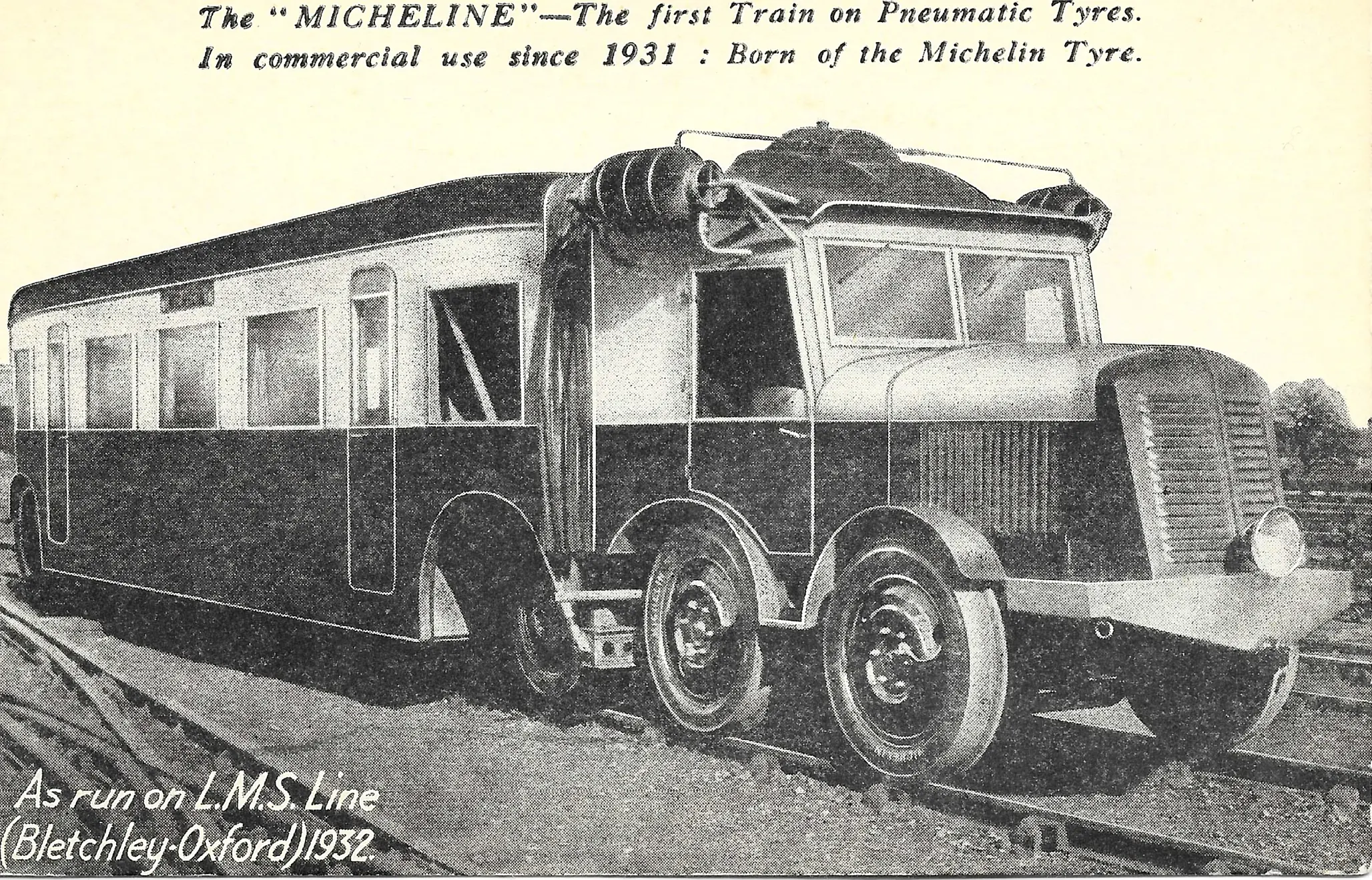
The ‘Micheline’ tyre train running on the LMS line: Postcard in the Vintage Transport Collection.
Click image to enlarge
Reverse of Postcard
The “MICHELINE” on pneumatic Tyres (inflated like motor car tyres) gives – faster MORE FREQUENT CHEAPER and more comfortable Travel. It very much reduces cost of Railway operation.
Video created by academy #
History #
- 1929: André and Édouard Michelin begin developing the pneurail, a steel flanged rubber pneumatic tyre designed to run on standard steel rails. They built four early experimental prototypes in Michelin’s workshops in Clermont-Ferrand, France.
- 10 September 1931: Prototype No. 5 (built from lightweight aviation grade Duralumin alloy) makes a high profile demonstration run between Paris and Deauville, covering the distance at high speed to showcase its smooth ride and rapid braking.
- September 1931: The Budd Company in the United States signs a licensing agreement with Michelin to build stainless steel pneumatic tyred railcars for American railroads, resulting in demonstrators and the Silver Slipper for the Texas and Pacific Railway.
- February 1932: Michelin brings the 24 seat articulated Type 9 railcar to Britain for trials on the London, Midland and Scottish Railway (LMS) between Bletchley and Oxford, alongside demonstrations on the GWR and Southern Railway. The Commercial Motor reports on 16 February 1932 that the vehicle accelerated from rest to 60 mph in 1 minute 45 seconds and stopped from 60 mph in just 210 feet.
- 1932: Following the prototypes, Michelin introduces the production Type 11 in France with 11 units being built, retaining the articulated 3 axle lorry style tractor and 24 seat rear passenger saloon.
- 1934: Michelin abandons the articulated lorry bonnet layout in favour of a 36 seat single body railcar on two 3 axle bogies with a raised conning tower driving cab, allowing bidirectional operation.
- 1935: Following British trials of the Micheline Type 9, Type 11, and a Type 22 demonstrator, Armstrong Siddeley, Michelin, and the LMS form the Coventry Pneumatic Railcar Company, building two 56 seat British engineered pneumatic railcars powered by 240 hp Armstrong Siddeley engines.
- 1936: Michelin scales up to 56 seat single body cars on 4 axle (16 wheel) bogies, such as the preserved Type 22 at the Cité du Train in Mulhouse and the three section articulated 108 seat Type 33.
- 1939 to 1952: Early articulated Michelines are withdrawn at the outbreak of the Second World War in 1939 and later converted into unpowered trailers, while the larger Type 23 units remain in regional French service until 1952.
- 1952: Once SNCF retired the final mainline Type 23 units in 1952, standard steel wheeled diesel railcars (such as the Renault ABJ and X 3800 Picasso series) took over regional routes. Many surviving Micheline bodies had their engines and pneumatic bogies stripped out and were converted into lightweight unpowered passenger trailers (remorques) before eventually being scrapped.